Tree removal is rarely as straightforward as cutting a tree at its base and bringing it safely to the ground. Many properties present unique challenges, with narrow side passages, neighbouring buildings, established gardens, steep terrain and overhead powerlines limiting access to the work area. These constraints increase the complexity of the job and require careful planning, specialised equipment and experienced arborists who can dismantle trees safely while protecting surrounding property and landscaping.
For tree removal in Sydney, understanding how arborists manage restricted-access sites helps property owners appreciate the expertise required for these complex projects. North Shore Tree Services applies proven planning, climbing, rigging and dismantling techniques to safely remove trees from confined and challenging environments across residential and commercial properties.
This article explains what makes a property difficult to access, why experienced arborists are essential for these removals, how complex jobs are planned and carried out, the methods used to protect buildings and gardens and why restricted access can influence both the time and cost of a project.
A property is considered difficult to access when standard tree removal methods or machinery cannot be used safely or efficiently. While some trees are easily reached from an open front yard, others are located behind homes, on steep slopes or within tightly developed suburbs where there is little room to work.
Restricted access affects far more than convenience. It influences the equipment that can be used, the removal method, the number of crew members required and the overall complexity of the project. Understanding these challenges helps property owners appreciate why some tree removals require significantly more planning than others.
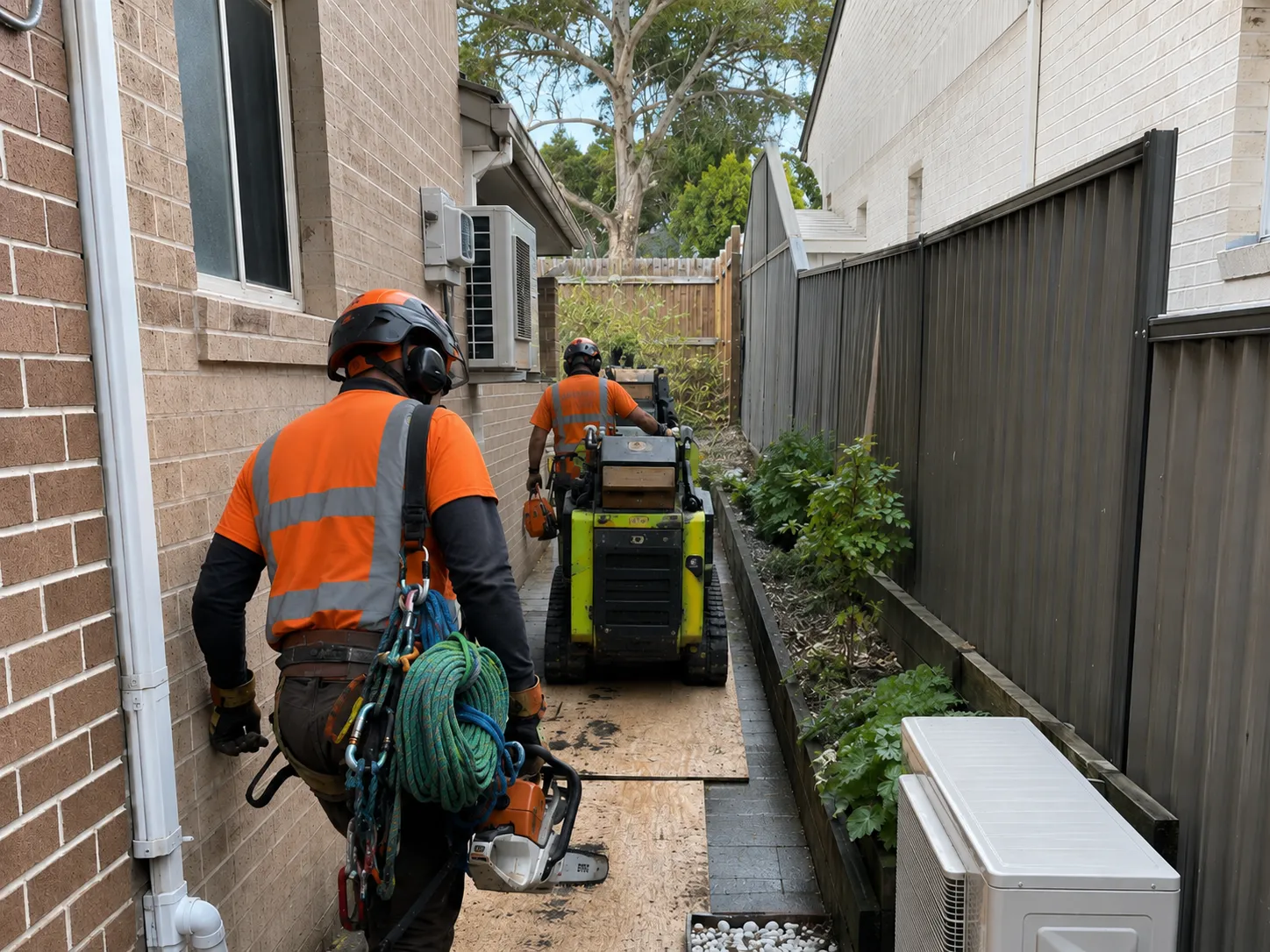
Many suburbs feature compact lots where houses occupy most of the available land. Narrow side passages, shared driveways and enclosed backyards often prevent vehicles or heavy machinery from reaching the tree directly. Common access restrictions are:
When machinery cannot reach the work area, arborists often dismantle the tree into smaller sections and transport branches and timber to the street. Although this approach takes longer, it allows the tree to be removed safely without damaging nearby structures.
Sydney's varied landscape means many homes are built on sloping blocks, elevated ridgelines or waterfront escarpments. These properties often present additional challenges because machinery cannot always be positioned safely on uneven ground. Steep sites may include:
These conditions require arborists to carefully plan how timber will be lowered and removed without creating unnecessary risks for workers or neighbouring properties.
Even when a tree is easy to reach, the surrounding environment can make its removal far more complex. Trees growing close to homes, pools, fences or neighbouring buildings leave little room for error during dismantling. Additional challenges often are:
In these situations, arborists cannot allow branches or trunk sections to fall freely. Instead, every piece is carefully controlled using specialised climbing and rigging techniques to avoid damage and maintain a safe work environment.
Additional precautions and service-provider requirements may apply when managing trees near powerlines, particularly where branches or climbing equipment could enter an unsafe clearance zone. Property owners in the Ausgrid network can also review current tree-trimming responsibilities near powerlines before arranging work around electrical assets.
Every access limitation influences how a removal is planned and carried out. Rather than relying on conventional felling techniques, arborists often dismantle the tree in controlled stages, selecting equipment and removal methods that suit the property's unique constraints.
Whether the challenge is a narrow backyard, a steep hillside or a tree surrounded by neighbouring homes, the objective remains the same: remove the tree safely while minimising disruption to people, property and the surrounding landscape.
Removing a tree from a restricted-access property requires far more than technical cutting skills. Every stage of the process must be carefully managed to protect people, nearby structures and the surrounding environment. Professional arborists combine specialist training, industry knowledge and purpose-built equipment to safely complete removals that would otherwise carry significant risks.
SafeWork NSW provides further guidance on the risks associated with professional tree work, including falls, falling objects, powerlines and hazardous equipment.
Engaging a qualified professional tree removal service gives property owners access to the training, equipment and controlled work practices needed to manage complex removals safely.
No two difficult-access properties are the same. Arborists must assess the tree's condition alongside site-specific constraints before deciding on the safest removal method.
Their experience allows them to determine whether a tree can be climbed safely, whether cranes or elevated work platforms are appropriate and how each section should be removed without placing unnecessary stress on surrounding structures. These decisions reduce risk while improving efficiency throughout the project.
Tree removal involves inherent risks that become greater when access is limited. Professional arborists follow established safety procedures, use appropriate personal protective equipment and carry out detailed risk assessments before work begins.
They also understand local council requirements, tree preservation controls and industry standards that may apply to a project. Where approvals are required, these considerations form part of the planning process to help ensure work is completed safely and in accordance with relevant regulations.
Property owners should review the applicable Sydney tree removal rules before scheduling work, as approval requirements can vary according to the council, tree and property.
Planning is the foundation of every successful removal on a restricted-access property. Before any cutting begins, arborists develop a removal strategy that considers the tree's condition, the property's layout, nearby hazards and the safest way to complete the work. This preparation helps minimise risks, improves efficiency and ensures the removal can be carried out with minimal disruption to surrounding homes and landscapes.
Rather than applying the same approach to every project, professional arborists tailor each removal plan to suit the unique challenges of the site.
The planning process begins with a comprehensive site inspection. Arborists assess the tree and its surroundings to determine the safest removal method and identify any factors that could affect the work. During the assessment, they typically consider:
Understanding these conditions allows arborists to anticipate potential challenges before work begins rather than responding to them during the removal.
Once the site has been assessed, arborists determine the safest and most practical method of removing the tree. The chosen approach depends on factors such as available working space, the tree's size and condition, surrounding structures and whether machinery can access the site. The removal plan typically outlines:
For confined sites, arborists often divide the tree into manageable sections that can be lowered individually rather than relying on traditional felling techniques.
Every difficult-access property presents different challenges, so equipment is selected to match the conditions of the site rather than following a standard approach. Depending on the project, arborists may use:
Using the right equipment not only improves safety but also helps reduce the impact on gardens, driveways and surrounding structures.
A well-planned removal also considers how the property will be protected throughout the project. Arborists identify potential hazards before work begins and implement measures to reduce risks for workers, occupants, neighbours and pedestrians.
By resolving issues before the first cut is made, arborists can complete the removal more safely and efficiently while reducing the likelihood of unexpected delays.
Removing a tree from a confined property requires techniques that provide complete control over every stage of the dismantling process. The method selected depends on the available working space, nearby buildings, the tree's condition and whether machinery can safely access the site.
Rather than relying on a single approach, arborists often combine several techniques to remove the tree safely while protecting surrounding structures and landscaping.
Sectional dismantling is the most common method used for tree removal on restricted-access properties. Instead of felling the tree in one piece, arborists remove it gradually from the top down, cutting manageable sections that can be safely controlled throughout the descent.
By working in stages, arborists maintain control over the removal while reducing the risk of damage to surrounding property.
When branches or trunk sections cannot fall freely, specialised rigging systems are used to lower each piece safely to the ground.
Using ropes, pulleys, friction devices and carefully selected anchor points, arborists guide timber away from buildings, fences and other obstacles while controlling its speed and direction.
Because every cut is carefully controlled, rigging allows arborists to remove even large trees from highly confined environments with minimal impact on the surrounding property.
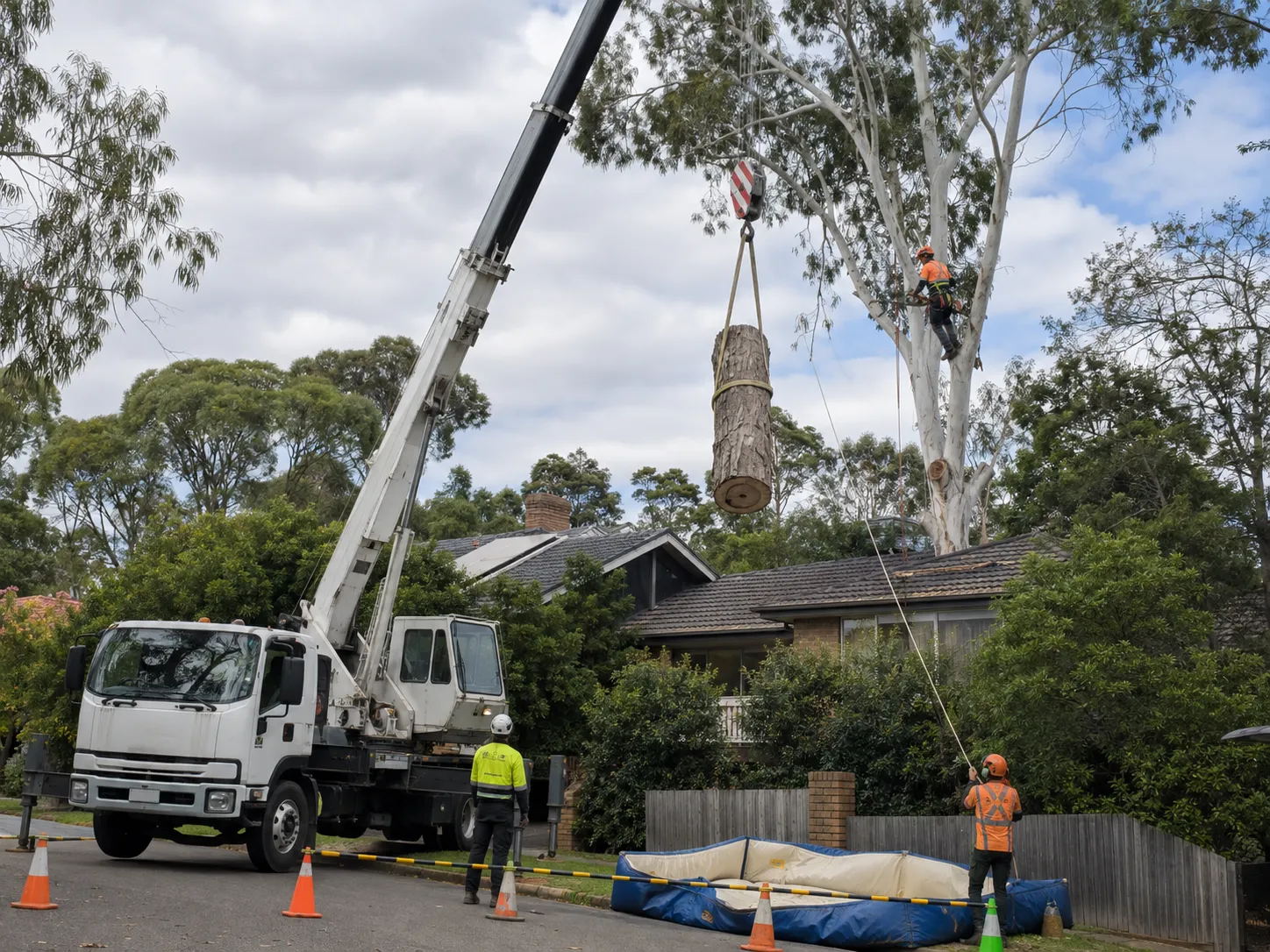
Some properties provide enough street or driveway access for a crane to assist with the removal. When conditions are suitable, crane-assisted removals can improve safety and efficiency by lifting large sections directly away from the tree.
Working together, the arborist secures each section before making a precision cut. The crane then lifts the timber vertically and transports it to a designated landing area, avoiding nearby buildings, gardens and other obstacles.
Not every tree can be climbed safely. Trees affected by extensive decay, storm damage or structural instability may require an elevated work platform instead.
Spider lifts and other compact elevated work platforms can often access areas that larger machinery cannot, making them well suited to narrow driveways and confined residential properties.
Where ground access permits, arborists may also use compact tracked loaders or similar machinery to transport timber and wood chips through restricted spaces. These machines reduce manual handling, improve efficiency and minimise disruption to the site while fitting through standard access gates.
On restricted-access properties, protecting the surrounding environment is just as important as removing the tree itself. Houses, fences, pools, driveways, gardens and neighbouring buildings often sit only metres from the work area, leaving little room for error. Every stage of the removal is planned to minimise the risk of damage while allowing the work to proceed safely and efficiently.
Rather than relying solely on careful cutting, arborists combine planning, specialised equipment and controlled work practices to safeguard the property throughout the project.
Protecting a property starts well before any branches are cut. During the site inspection, arborists identify features that could be affected by the removal and develop a strategy to work around them.
By recognising the risks early, arborists can choose equipment and removal techniques that reduce the likelihood of accidental damage.
On confined properties, allowing branches or timber to fall freely is rarely an option. Instead, arborists use controlled dismantling methods that keep every section of the tree under control from the moment it is cut until it reaches the ground.
Depending on the site, this may involve rope systems, rigging equipment, cranes or elevated work platforms that allow branches and trunk sections to be lowered safely into predetermined landing areas.
Breaking the tree into smaller sections provides greater precision and reduces the forces placed on nearby structures. It also allows arborists to work safely around roofs, glass, solar panels, fences and neighbouring properties without exposing them to unnecessary risk.
Mature gardens and carefully designed landscapes often represent years of investment, so arborists take practical steps to minimise disturbance throughout the removal process. Protection measures may include:
Where manual handling is required, crews also take care to transport timber and equipment in ways that minimise damage to lawns, pathways and surrounding vegetation.
Restricted access is one of the biggest factors influencing the time and cost of a removal project. While the size and condition of the tree remain important considerations, limited working space often determines how the removal is carried out and the resources required to complete it safely.
Properties with narrow access points, steep terrain or nearby structures require more planning, additional labour and specialised equipment than sites with open access.
On an open site, arborists may be able to remove larger sections of a tree and move them quickly using machinery. On a confined property, however, each branch and trunk section often needs to be dismantled, lowered in a controlled manner and transported manually to the street or collection point. Several factors can extend the duration of a project, including:
Although these methods take more time, they improve safety and help prevent costly property damage.
The cost of removal reflects the complexity of the work rather than simply the tree size. Restricted-access projects often require additional planning, specialised equipment and larger crews to complete the removal safely. Factors that may increase costs include:
Every property is different, so quotations are typically based on a site inspection that allows arborists to assess the specific challenges involved.
Preparing your property before the arborists arrive helps the project run more smoothly and safely on sites with restricted access. While the removal crew will manage the technical aspects of the work, a few simple preparations by the property owner can improve access, reduce delays and help protect surrounding areas.
These steps also allow arborists to focus on the removal itself rather than spending valuable time clearing obstacles or resolving avoidable access issues.
Where access to the tree is limited, every available pathway becomes important. Before the scheduled removal, property owners should ensure the agreed access route is clear so workers can safely move equipment, branches and timber.
If access involves shared driveways or common property within a strata complex, it is also worthwhile confirming any building requirements before the work begins.
Although arborists take extensive precautions to protect the property, removing or securing valuable items provides an additional layer of protection during the project.
Closing windows and keeping outdoor areas clear also helps reduce the chance of dust or small debris entering the home.
Tree removal can temporarily affect neighbouring properties, particularly when work is taking place near a shared boundary or when large vehicles need access to the street.
Providing neighbours with advance notice helps minimise inconvenience and allows them to prepare for temporary noise, restricted parking or increased activity around the property. Good communication is especially beneficial where branches extend across property boundaries or where access arrangements have been agreed upon beforehand.
Removing trees on difficult-to-access properties requires more than cutting down a tree. It demands planning, specialised equipment and skilled arborists who can safely manage risks while protecting nearby buildings, gardens and surrounding landscapes. Through site assessments, controlled dismantling techniques and the appropriate use of rigging systems, cranes or elevated work platforms where needed, even the most challenging properties can be managed safely and efficiently. North Shore Tree Services brings the expertise and professional approach required to complete complex tree removals with a strong focus on safety, compliance and protecting the value of every property.