Trees growing close to roofs, walls and other structures require careful management to protect both the property and the long-term health of the tree. North Shore Tree Services provides professional tree lopping in Sydney, including carefully planned clearance pruning for trees growing near homes, garages and other structures. While mature trees can improve shade, privacy and street appeal, unmanaged branches may damage roofing materials, block gutters, restrict access and increase the risk of storm-related property damage.
These issues are particularly common across Sydney’s North Shore, where established trees often grow within a short distance of homes. Appropriate pruning can help maintain a practical separation between the tree and the building without unnecessarily compromising the tree’s structure, appearance or health.
This article explains why trees may require clearance from roofs and buildings, how arborists assess site-specific risks, which pruning methods support healthy growth and what council or safety restrictions may apply before work begins. Understanding these factors helps property owners protect their homes while retaining the benefits of mature trees.
Trees contribute shade, character and value to Sydney properties, yet branches growing too close to roofs, walls and other structures can create avoidable maintenance and safety problems.
Clearance pruning is not intended to remove trees simply because they are near a building. Its purpose is to manage individual branches that are touching, overhanging or likely to affect the structure as they grow or move in the wind.
A well-planned approach can reduce damage while preserving as much healthy canopy as possible.
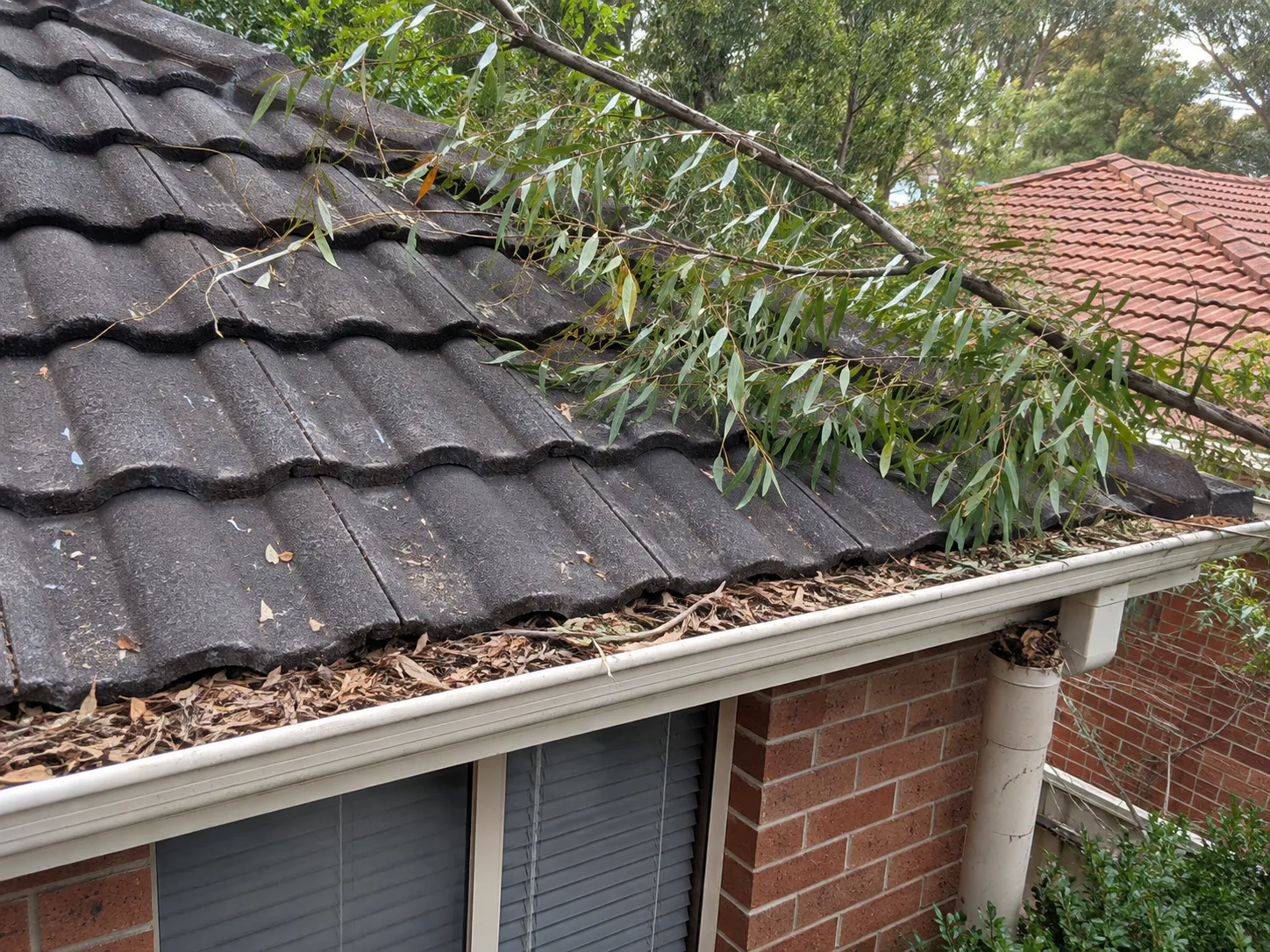
Branches that repeatedly rub against roof tiles, metal sheeting, ridge cappings or gutters can gradually damage these materials. Wind movement may cause branches to chip tiles, loosen pointing or wear protective coatings from metal roofing.
Older terracotta tiles can be particularly vulnerable to impact and abrasion, even from branches that do not appear especially large.
Branches overhanging the roof can also deposit:
This debris may accumulate in gutters, valleys and downpipes, restricting water flow during heavy rain. Overflowing gutters can contribute to deterioration of fascia boards, soffits, wall linings and roof framing. Persistent moisture may also encourage mould growth and internal water staining.
Pruning selected branches away from vulnerable roof areas can reduce direct contact and limit the amount of material falling into difficult-to-clean sections.
Sydney regularly experiences strong winds, thunderstorms and periods of intense rainfall. During these conditions, long or heavily weighted branches extending over a building may place additional force on branch unions and supporting limbs.
The risk associated with a branch depends on more than its position. Arborists also consider:
Where appropriate, selective reduction pruning can shorten a branch and reduce its leverage while retaining a healthy lateral branch and a natural canopy shape.
Where the tree remains healthy and structurally manageable, crown reduction may be preferable to complete removal, particularly when the objective is to reduce branch weight or improve clearance while retaining the tree.
Not every overhanging branch is dangerous, and removing too much foliage can create new structural or health problems. A site-specific assessment is therefore more reliable than assuming that all branches above a roof must be removed.
In bushfire-prone parts of Sydney, vegetation close to a building may contribute to fuel accumulation or allow branches and foliage to extend close to eaves and roofing.
Dry leaves collecting in gutters can be vulnerable to ember attack. Dense vegetation immediately beside a building may also affect access, airflow and the separation between combustible material and the home.
Tree pruning is only one part of broader bushfire preparation. Property owners should also consider gutter maintenance, surrounding vegetation, building design and any requirements that apply to mapped bushfire-prone land.
The NSW 10/50 Vegetation Clearing Scheme may allow certain vegetation work on eligible properties, but it applies only in designated areas and remains subject to specific conditions. Eligibility should be confirmed before work begins.
Property owners can use the NSW Rural Fire Service tool to check whether their property is in a 10/50 area before relying on the scheme.
Dense canopies can keep roofs, walls and paved areas shaded for long periods after rain. Reduced sunlight and airflow may allow surfaces to remain damp, increasing the likelihood of mould, corrosion, algae growth and deterioration of exterior coatings or sealants.
Branches in contact with cladding, fences, pergolas or balconies may also cause damage as they move or increase in diameter. Over time, this pressure can affect lightweight structures, railings, gutters and downpipes.
Clearance pruning may also be needed where branches:
The amount of pruning required depends on the tree, the building and how the surrounding space is used.
An arborist assessing a tree near a building considers both immediate risks and the tree’s likely future growth. The objective is to manage branches that may damage the structure while retaining a stable, healthy and balanced canopy.
Most inspections begin from ground level. Closer inspection from within the canopy or with specialist equipment may be recommended when defects cannot be adequately assessed from below.
The first step is to identify how branches, trunks and roots relate to the surrounding structures.
An arborist may look for:
Future growth is also important. A branch that is currently clear of the roof may come into contact with it within one or two growing seasons.
Species, age, vigour, available soil moisture and previous pruning can all influence how quickly the canopy expands.
There is no single clearance distance that is suitable for every tree and building.
Depending on the species, branch flexibility, roof design, wind exposure and rate of regrowth, an arborist may recommend enough separation to:
A clearance of approximately 1.5 to 2 metres may be suitable in some situations, but it should not be treated as a universal requirement. Some trees may need more space, while others can be retained closer to a structure without creating an unacceptable risk.
The objective is to establish a practical and sustainable buffer rather than cutting every canopy to an arbitrary line.
A tree can grow close to a building without presenting a high level of risk if it is healthy, structurally sound and appropriately managed.
An arborist may assess:
Trees with significant defects may require more detailed investigation, monitoring or remedial work. However, the presence of a defect does not automatically mean that the tree must be removed.
The likelihood of failure and the potential consequences must both be considered.
Roots near paths, retaining walls, pipes and building footings should be assessed carefully.
Large woody roots may displace lightweight paving, garden edging or older structures in some circumstances. Fine roots are generally less likely to cause direct structural movement, although they may enter damaged pipes or affect soil moisture around existing defects.
Arborists may inspect for:
Trees growing in fill, compacted soil or disturbed ground may have uneven root development. This can be relevant when assessing stability, especially following excavation, trenching or building work.
Tree roots should not be cut simply because they are close to a structure. Removing major structural roots can destabilise the tree and may create a greater hazard than the original problem.
Clearance pruning should create useful separation from the building without leaving the tree unbalanced, excessively reduced or vulnerable to decay.
The method used depends on the size, position and condition of the branches involved.
Priority may be given to branches that are:
Where possible, the arborist may reduce a branch rather than remove it entirely. This can preserve canopy cover while redirecting future growth away from the structure.
Branches removed at their point of origin should generally be cut just outside the branch collar. This supports the tree’s natural compartmentalisation response and reduces unnecessary injury to the trunk or supporting limb.
Cuts should not be made flush with the trunk, and long stubs should not be left behind.
Where a branch needs to be shortened, a reduction cut should be made back to a suitable lateral branch capable of assuming the terminal role. The retained lateral should be large enough to support continued growth and reduce the likelihood of excessive sprouting.
Heading cuts and topping should be avoided. These methods remove branches without regard to natural growth points and often trigger clusters of vigorous, weakly attached shoots.
Removing too much live foliage in a single visit can stress the tree, reduce energy production and encourage dense regrowth.
The amount that can be safely removed depends on:
A limit of around 20 to 25 per cent is sometimes used as a broad upper guide for healthy, established trees, but this should not be treated as a target or universal rule. Many trees require substantially less foliage removal.
Mature, declining or sensitive trees may respond poorly to heavy pruning and may need staged work over several years.
Different species respond differently to pruning.
Fast-growing trees may quickly regrow into the cleared space, while some mature trees are less tolerant of large cuts or significant canopy reduction.
Sydney’s climate can encourage active regrowth when soil moisture and temperatures are favourable, but the response varies according to species, season and tree condition.
Heavier pruning should generally be avoided during periods of extreme heat, drought or other environmental stress unless urgent safety work is required.
Tree work close to buildings requires careful planning to prevent the pruning process itself from causing damage.
Before cutting begins, the arborist should identify vulnerable surfaces, suitable work positions, access restrictions and safe paths for lowering branches.
A pre-work inspection may consider:
Property boundaries and access arrangements should also be confirmed where branches extend over neighbouring land.
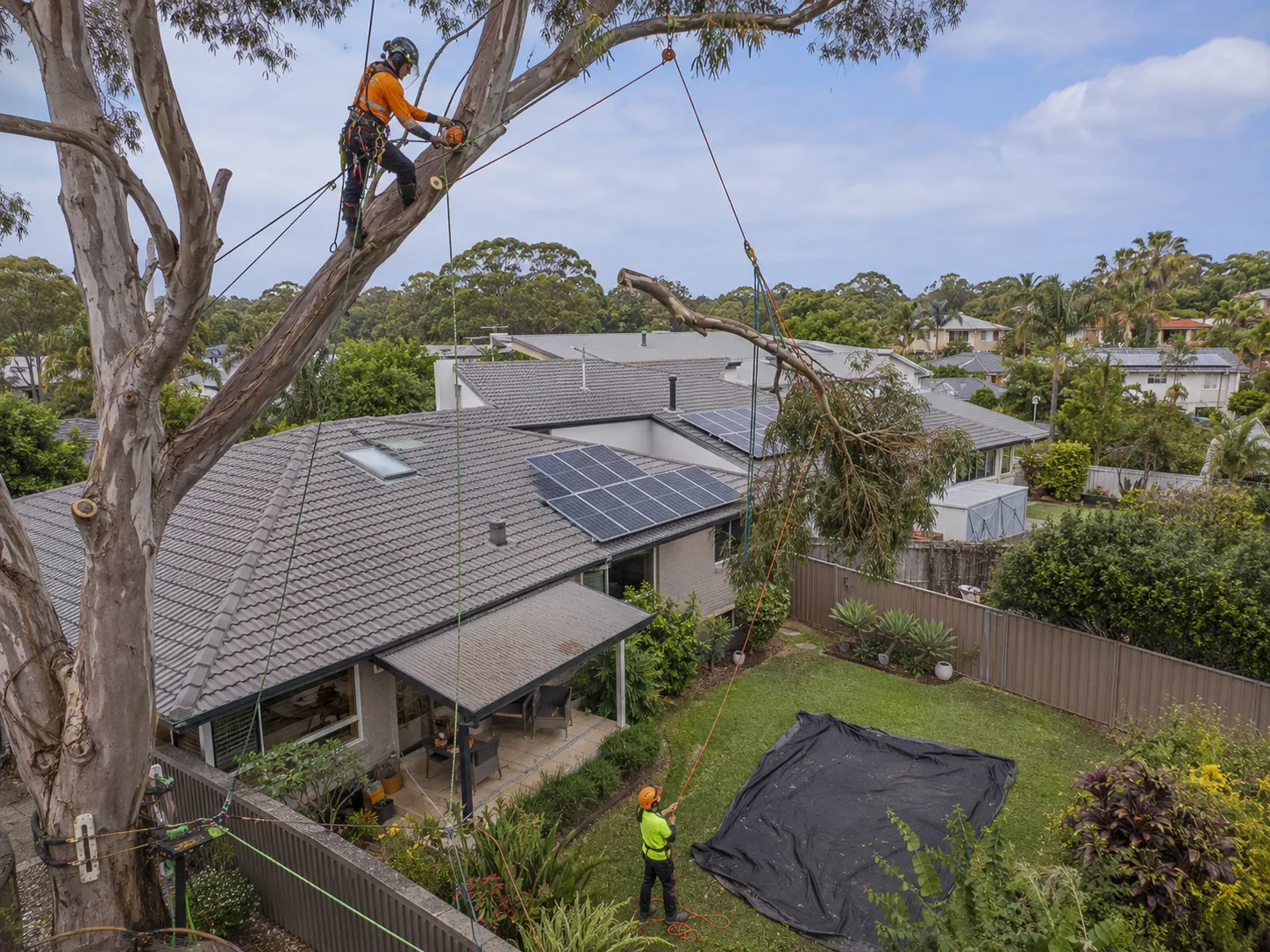
Where branches cannot be safely allowed to fall, arborists may use controlled dismantling and rigging techniques.
Branches can be cut into manageable sections, secured with ropes and lowered into a designated area. Friction devices, pulleys and suitable anchor points may be used to control the direction and speed of descent.
Branches extending directly over a roof may be secured at one or more points before being cut. This allows the arborist and ground crew to move the section away from the building and lower it without striking roofing, solar panels or skylights.
The exact technique depends on branch weight, canopy structure, available anchor points and the condition of the tree.
Vulnerable areas may be protected with suitable boards, mats, padding or heavy-duty coverings.
Outdoor furniture, barbecues, pot plants and vehicles should be moved away from the work zone. Access routes should be planned to reduce damage to lawns, irrigation systems, garden beds and exposed roots.
Debris should be removed progressively rather than being dragged across walls, paving or delicate landscaping.
After the work, gutters and roof valleys beneath the pruning area should be checked for leaves and small debris.
Branches growing near powerlines require specialist attention.
Additional clearance requirements and service-provider restrictions may apply when managing trees near powerlines, particularly where branches, climbing equipment or machinery could enter an unsafe electrical zone.
Property owners should not attempt to prune vegetation near electrical conductors. Even branches that are not touching a line may present a risk because electricity can arc across a gap or travel through vegetation and equipment.
The appropriate response depends on whether the branches are near:
Work near network powerlines may need to be arranged through the electricity distributor or completed by a contractor authorised and qualified for vegetation management near electrical infrastructure.
Ausgrid provides further information about tree-trimming responsibilities near powerlines, including the qualifications required for work within specified electrical clearance zones.
A general tree contractor should not undertake this work unless the required electrical clearances, training and authorisations are in place.
Where branches are close to a service line, the arborist may need to coordinate with the property owner, electricity provider or licensed electrical contractor before pruning can proceed.
Tree pruning and removal controls vary across Sydney. Requirements can differ between neighbouring council areas and may depend on the tree’s species, size, location, condition or heritage value.
Before arranging significant pruning, property owners should check the current rules for the relevant local government area.
Tree controls may be contained in:
Council approval may be needed where pruning would:
Some councils use height, trunk diameter, canopy spread or species-based thresholds to determine whether a tree is protected. Because these measurements and definitions vary, general figures should not be relied upon without checking the applicable council rules.
Tree removal usually requires a stronger justification than minor clearance pruning. The fact that a tree is close to a building may not be sufficient on its own.
Where structural damage, unacceptable risk or tree decline is claimed, an arborist report may be required.
Some councils allow limited maintenance without formal approval. Depending on the area, this may include:
Exemptions are not consistent across Sydney. Terms such as “minor pruning,” “deadwood” and “acceptable clearance” may have specific definitions.
Property owners should obtain written confirmation where the rules are unclear and retain records of any exemption relied upon.
Pruning should also be consistent with AS 4373, Pruning of Amenity Trees, where the standard is required by council controls, project documentation or accepted industry practice.
Additional restrictions may apply because of:
These issues should be considered before work is scheduled so that approvals, access and protective measures can be organised in advance.
There is no fixed pruning interval suitable for every tree.
The frequency of clearance work depends on:
Many trees near buildings may benefit from a visual inspection each year, particularly before Sydney’s summer storm season. This does not mean that pruning must be completed annually.
Actual pruning should be carried out when branch growth, structural condition or changing site circumstances justify the work.
Some fast-growing trees may close the gap between the canopy and the building within 12 to 18 months. More frequent maintenance may be appropriate where branches extend over gutters, solar panels or vulnerable roofing.
The pruning interval may also shorten where trees receive additional water from irrigation, drainage lines or naturally moist soil.
Trees with moderate growth may only need clearance pruning every two to three years when suitable separation was established during the previous visit.
Slower-growing or well-positioned trees may remain clear of buildings for longer, particularly where they have been structurally pruned from a young age.
Property owners should arrange an assessment sooner when they notice:
A fixed calendar should not replace observation. Tree condition and site circumstances can change between scheduled visits.
Managing trees near roofs and buildings requires more than cutting back every overhanging branch. Effective clearance pruning considers tree health, structural stability, future growth, property protection and the regulations that apply to the site.
When the work is carefully planned, it can reduce roof and gutter damage, improve access, limit branch contact and lower the consequences of branch failure. It can also preserve the shade, privacy, habitat and visual value that mature trees provide.
Because every tree species, building and property layout is different, pruning decisions should be based on a site-specific assessment rather than a fixed clearance distance or pruning schedule.
North Shore Tree Services provides professional tree lopping in Sydney and can assess trees growing near homes, roofs and other structures. With appropriate pruning and ongoing inspection, mature trees can continue to enhance the property without creating unnecessary risks for the building or its occupants.