Trees growing near a pool fence can affect compliance in NSW when branches, trunks, roots or dense vegetation create climbable points or interfere with the required barrier clearance. Even trees planted for shade or privacy can become a concern as they grow, making regular maintenance an important part of keeping the pool area safe and compliant.
North Shore Tree Services helps property owners identify tree-related issues that may affect pool fence safety. Professional tree services in Sydney can help manage these issues through appropriate pruning, tree assessment and ongoing maintenance while considering the health and structure of the trees.
This article looks at how trees and shrubs can affect pool fence compliance, what vegetation is most likely to create problems and how property owners can manage growth around the required non-climbable zones. It also covers pruning, tree removal, responsibility for neighbouring trees and the council requirements that may apply before tree work begins.
The non-climbable zone around a pool fence is the area that needs to remain free of objects a child could use to climb over the barrier. Trees, shrubs, garden features and other objects can become a concern when they provide footholds, handholds or other climbing aids near the fence.
The location of an object in relation to the barrier is important. A tree does not need to touch the fence to create a potential compliance issue. Its branches, trunk, exposed roots or surrounding landscaping may extend into an area that needs to remain clear.
Common features that may affect the area around a pool fence include:
Changes can also occur eventually. A tree that was well clear of the fence when planted may develop wider branches, exposed roots or dense growth as it matures. Regular checks can help identify these changes before they create a more serious pool safety concern.
The type of tree is not necessarily the main concern. Instead, attention should be given to the way its branches, trunk, roots or surrounding growth interact with the pool barrier. Growth that creates a foothold, handhold or natural step can make the barrier easier to climb.
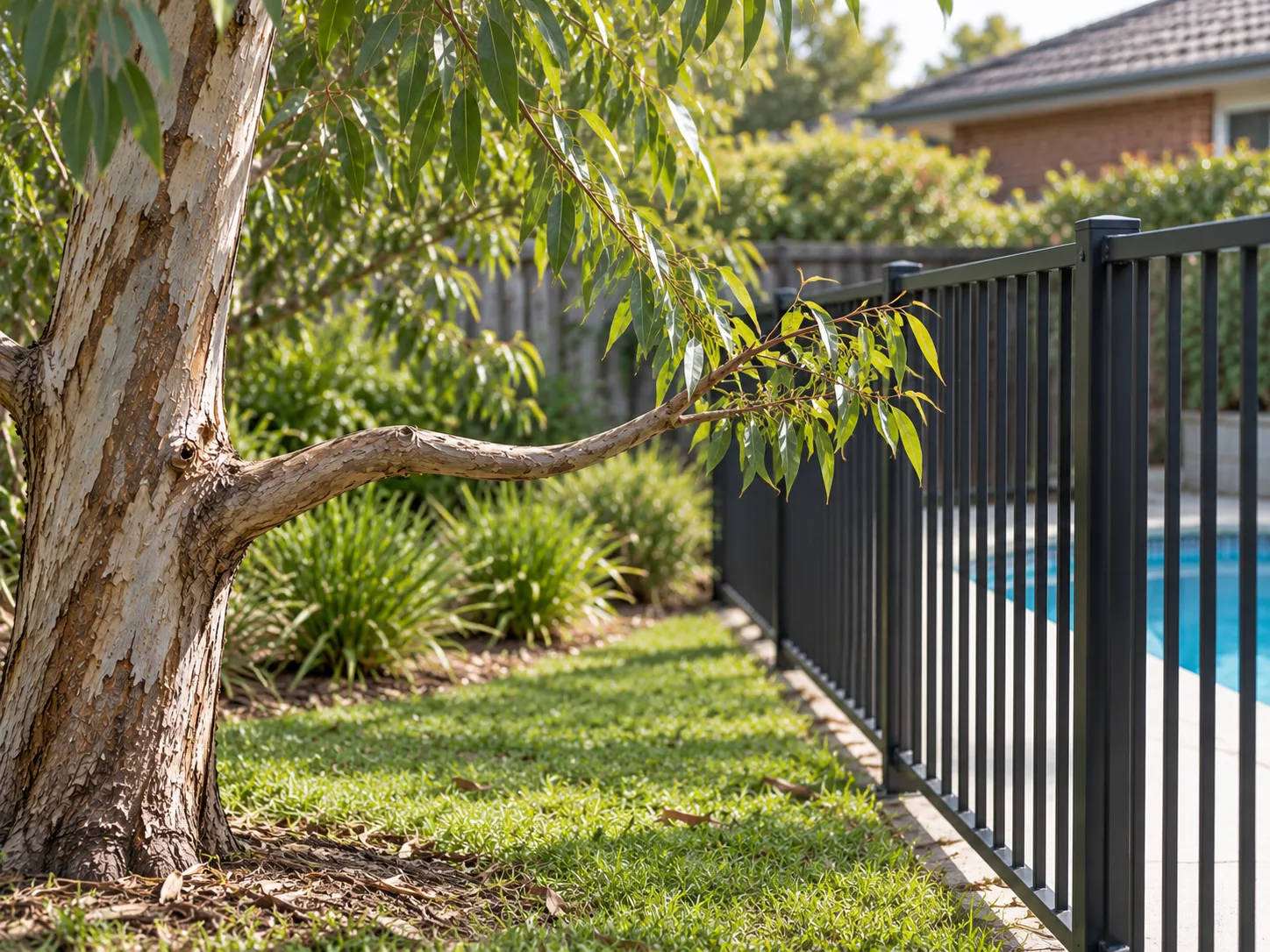
Some tree-related problems are:
Neighbouring trees can create similar issues where branches extend across a property boundary. The position of the branch in relation to the pool barrier still needs to be considered, even when the tree itself is located elsewhere.
However, pruning a neighbouring tree should not be arranged without considering ownership, property boundaries and applicable council controls. Where a tree is on shared or strata property, the relevant owner or managing body may also need to be involved.
Trees should be positioned and maintained so that trunks, branches, roots and surrounding landscaping do not create climbable points within the areas that need to remain clear around the pool barrier. The relevant clearance should be measured from the fence rather than simply from the tree trunk, as branches and other growth can extend into the restricted area even when the trunk is further away.
Clearance should also account for the tree's mature size and natural growth pattern. A young tree may have adequate space when planted but develop low branches, a wider canopy or exposed roots that eventually affect the pool barrier.
Regular checks should consider the following:
Allowing sufficient space from the outset can reduce ongoing pruning requirements and help protect tree health and pool fence safety. Where an established tree is already close to a pool fence, an arborist can assess whether pruning, landscaping changes or another management option is appropriate.
Tree roots can affect pool fence safety when they raise the ground, lift paving or place pressure on nearby fence structures. Exposed roots may create footholds, while larger roots can contribute to movement or damage around fence posts, footings and surrounding surfaces.
Regular checks can help identify root-related changes before they become more difficult to manage. Beware of these issues:
Root pruning is not always a suitable solution. Removing major structural roots, particularly close to the trunk, can affect a tree's stability and health. An arborist can assess the root system and surrounding fence before recommending whether root management, landscaping changes, fence repairs, pruning or another approach is appropriate.
Early attention to raised roots, damaged paving or movement around fence posts can help prevent a minor issue from becoming a larger pool safety or structural problem. Professional tree services can assist with assessing trees near pool barriers and determining an appropriate approach for the tree and fence.
Fallen leaves, twigs, bark, fruit and other tree debris do not automatically make a pool fence non-compliant. However, heavy accumulation can contribute to maintenance and safety problems around the barrier, where debris builds up against landscaping, roots or other objects.
Large branches or fallen fruit can also obstruct a pool gate or interfere with its ability to close and latch properly. Accumulated material may make it harder to identify other problems, such as raised roots, damaged paving or objects that have entered the area around the fence.
Regularly clearing debris from the fence and gate can help keep the barrier unobstructed and make changes easier to spot. Where a tree consistently produces substantial debris near the pool, appropriate pruning may help reduce the problem. An arborist can assess the tree and recommend suitable maintenance while considering its health and the required pool fence clearance.
Pruning can be enough to restore pool fence clearance when limited branch or foliage growth is the main issue. Selective trimming can remove potential climbing points while allowing the tree to remain in place, provided the work does not compromise its health or structure.
Pruning is suitable where the problem involves growth that can be removed without significantly altering the tree. Here are some examples:
Where these issues can be resolved with targeted pruning, ongoing maintenance may provide practical alternatives to removal while preserving the tree’s health and maintaining pool fence clearance.
Pruning may not be suitable where a tree has thick low branches, multiple stems or a trunk positioned too close to the fence. It may also be impractical when maintaining clearance would require repeated heavy pruning or affect the tree's natural structure.
An arborist can assess whether further pruning is appropriate or whether another management option should be considered. If removal becomes necessary, applicable council requirements still need to be checked before work begins.
Trees continue to grow after corrective pruning, so pool fence clearance needs to be monitored. New shoots, spreading branches and dense foliage can gradually return to the area around the barrier with fast-growing species.
Regular tree maintenance can help identify regrowth early and keep vegetation from becoming a larger pool safety concern. A suitable pruning schedule can also reduce the need for more extensive corrective work later.
Tree removal near a pool fence may be considered when pruning or other management options cannot resolve an ongoing safety or clearance problem. Removal is a more complex step and should be considered after the tree, fence and available management options have been assessed.
Removal may be considered when a tree's trunk, major branches or multiple stems are positioned too close to the pool fence to maintain suitable clearance through reasonable pruning. This can occur where:
An arborist can assess whether the tree can be safely managed through pruning or whether removal is a more suitable long-term option.
Removal may also be considered where root growth is contributing to problems around the pool barrier, like raised paving, displaced fence posts or repeated movement around the fence.
The tree and fence should be assessed together before removal is considered. In some cases, repairing the barrier or changing surrounding landscaping may resolve the problem without removing the tree.
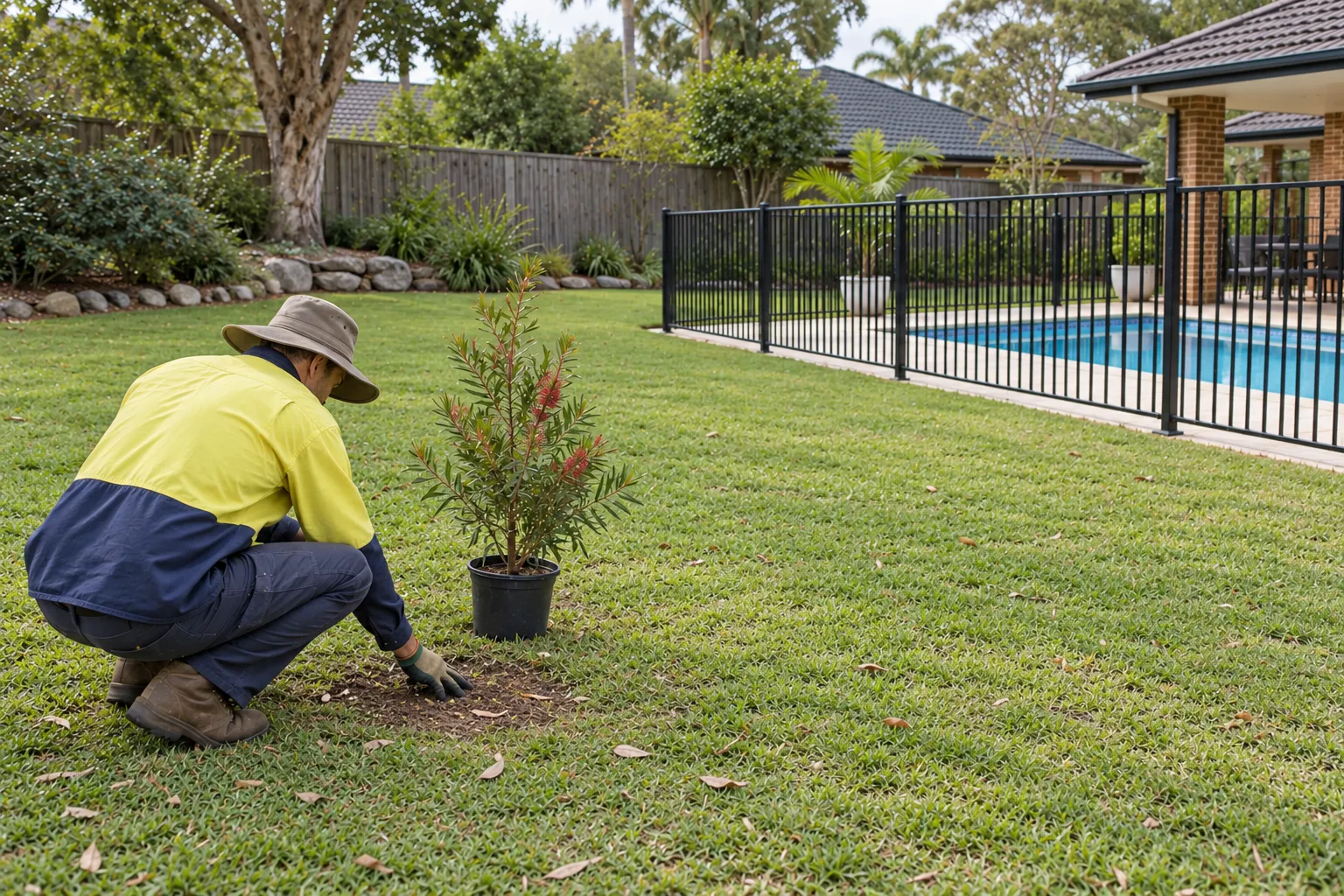
A tree that repeatedly causes clearance problems or requires frequent heavy pruning may become difficult to manage over the long term. Where reasonable maintenance cannot keep the area around the pool barrier clear, removal and replacement with a more suitable tree may be considered.
Any proposed removal should first be checked against applicable council tree controls. Where removal is permitted, selecting an appropriate replacement species and planting position can help prevent similar problems in the future.
The person responsible for maintaining a pool barrier also needs to ensure that vegetation and other objects do not compromise its safety or required clearance. This includes trees growing elsewhere on the property where their branches, roots or surrounding growth affect the fence.
Responsibility can become more complicated when a tree grows on neighbouring or shared property. Overhanging branches extending towards a pool fence may need to be addressed to maintain the barrier, but the pool owner cannot necessarily prune or remove the tree without considering property boundaries, council controls and the tree owner’s rights.
Where neighbours cannot agree on how to manage a tree-related concern, the NSW Land and Environment Court provides information about tree disputes and the available resolution process.
Trees on strata or common property may also require approval from the owners corporation or another responsible party before work is arranged. The cost of maintenance will depend on who owns or controls the tree and what arrangements apply to the property.
Where a tree is creating a pool fence concern, the issue should first be identified and assessed rather than assuming removal is necessary. An arborist can recommend suitable tree work, while a pool safety professional can assess whether the barrier itself meets the applicable safety requirements.
Council approval may be required before pruning or removing a tree near a pool, depending on the local council's tree protection controls. A tree affecting pool fence clearance is not automatically exempt from these requirements. Controls can vary according to factors such as the tree's species, size, location and the type or extent of work proposed.
Before arranging tree work, property owners should check the relevant council requirements, where the tree is protected or substantial pruning or removal is proposed. Some minor pruning or particular types of trees may be exempt, but the conditions vary between council areas. Root pruning may also require consideration where it could affect the health or stability of the tree.
If a tree is affecting pool fence compliance, the issue should be assessed from both perspectives. A pool safety professional can identify what needs to change around the barrier, while an arborist can determine whether pruning or removal is appropriate. Any required council approval should be confirmed before tree work begins.
Professional tree services can help identify and manage vegetation that may affect pool fence clearance. An arborist can assess branches, trunks, roots and surrounding growth to determine whether pruning or another form of tree maintenance is appropriate.
A tree assessment can identify issues like low branches, dense growth, exposed roots, lifted paving and branches likely to enter the required clear area. Considering the tree's current condition and future growth can also help determine whether ongoing pruning is likely to be practical.
Where the tree can safely remain in place, selective pruning can remove branches and foliage that interfere with the pool fence. Root-related problems may also require assessment where raised roots, lifted paving or pressure around fence posts affect the area around the barrier.
Root pruning should be approached carefully because removing major roots can affect tree stability and health. An arborist can determine whether root management is appropriate or whether landscaping changes, fence repairs or another solution would be safer.
Trees continue to grow, so pool fence clearance can change over time. Regular inspections and scheduled pruning can help prevent branches, foliage or roots from creating new hazards, around mature or fast-growing trees.
Tree work must also comply with applicable council controls and property requirements. Where a tree is protected or grows across a boundary, approval or coordination with the relevant property owner may be necessary. Professional tree services can help assess the vegetation and recommend suitable maintenance, while a pool safety professional can confirm whether the barrier meets the applicable standards.
Trees around a pool fence can affect compliance through climbable branches, trunks, exposed roots, raised landscaping, fallen debris or changes to the barrier. Regular inspections and appropriate maintenance can help keep the required clear areas around the fence free from potential hazards.
North Shore Tree Services can assist with assessing and managing trees near pool fences through appropriate pruning and ongoing tree care. Proactive maintenance can help protect tree health while supporting a safe and compliant pool area.